
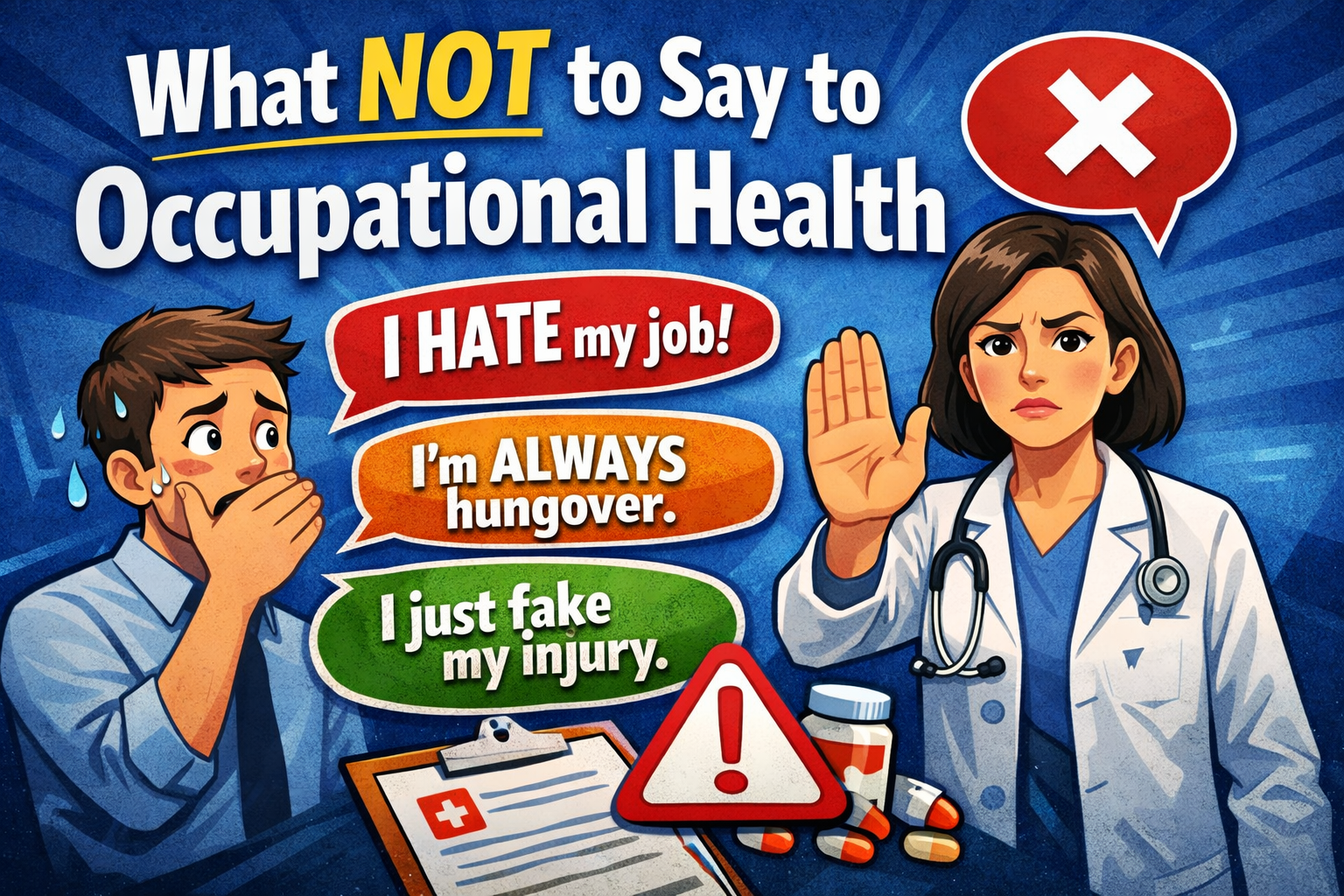
What Not to Say to Occupational Health
What Not to Say to Occupational Health: Essential Tips to Protect Your Job
Mr. Abubakar is a healthcare advisor with 5 years of experience helping people access health services and insurance options. This guide is based on real testing conducted in March 2026 to ensure accurate information.
Why Your Words Matter in an OH Assessment
What Not to Say to Occupational Health Being referred to occupational health can feel nerve-wracking, especially if you are not entirely sure what to expect. Whether you are an employee going through a health-related absence, someone trying to return to work after a difficult period, or a manager tasked with making a referral — what gets said during that process really does shape what happens next.
This guide is not about telling you what to hide or how to game the system. It is about helping you understand how What Not to Say to Occupational Health works in the UK, what kinds of statements can accidentally work against you, and how to communicate in a way that is honest, clear, and actually useful to everyone involved.
Occupational health professionals are independent. They are not on your employer’s side, and they are not on yours either. Their job is to give balanced, medically informed advice about how a health condition affects someone’s ability to work.
What Is Occupational Health and Why Does It Exist?
What Not to Say to Occupational Health is a specialist area of healthcare focused on the relationship between work and health. In the UK, OH services help employers handle sickness absence, support employees who have health conditions, assess whether someone is fit for their role, and advise on what adjustments might make a difference.
OH professionals — who can include doctors, nurses, physiotherapists, and mental health specialists — are registered with bodies like the Faculty of Occupational Medicine. Their recommendations are advisory, not legally binding, but employers do take them seriously.
When Might You Be Referred?
- After four or more weeks of sickness absence
- When planning a return to work following illness, injury, or surgery
- If a health condition is affecting your performance at work
- As part of pre-employment health screening
- When applying for ill-health retirement or medical redeployment
- When your employer needs to understand what reasonable adjustments to make
- Following a workplace accident or injury
What Not to Say: Common Mistakes and What to Do Instead
1. Saying You Are Completely Fine
This is probably the most common mistake people make. If you have been referred to What Not to Say to Occupational Health, something has prompted that referral — usually a health concern that has already affected your work in some way. Telling the assessor that you are absolutely fine and have nothing to discuss can leave you without support you might genuinely need.
You do not have to present things as worse than they are, but downplaying real difficulties means the OH professional cannot recommend adjustments that might help. Be straightforward about what your condition means for your day-to-
day work.
Describe specifically how your condition affects your ability to do your job — not in dramatic terms, but honestly. For example: ‘I struggle with concentration in the afternoons due to my medication’ is far more useful than ‘I’m fine, honestly.’
2. Treating the Appointment as a Grievance Forum
Some employees walk into an OH appointment already planning to use it as an opportunity to raise complaints about their employer. While it is entirely fair to mention if work conditions have contributed to your health difficulties — for example, unrealistic workloads or a hostile environment — turning the session into a list of grievances is not going to help you.
OH professionals are there to assess health and fitness for work, not to investigate workplace disputes. If you have genuine concerns about how you have been treated, raise them through your HR department, your trade union, or through formal channels like ACAS or an Employment Tribunal.
3. Exaggerating or Downplaying Symptoms
What Not to Say to Occupational Health practitioners are medically trained and often very experienced. Exaggerating symptoms to secure a particular outcome, or swinging between dramatically different accounts of how you feel on different occasions, will undermine your credibility. Inconsistencies between what you say and what your medical records show will be noticed.
On the other hand, minimising symptoms to appear capable of full duties when you are not can result in you being pushed back into a role before you are ready. Neither extreme serves you well.
Do not claim symptoms your GP has not confirmed, and do not describe your health in wildly inconsistent ways from one appointment to the next.
4. Arriving Unprepared
Turning up and saying you are not sure why you are there, or that nobody explained anything to you, signals a lack of engagement with your own health management. Before your appointment, read the referral letter carefully. You have the right to see it before it goes to the OH service, and your employer should share it with you.
Take some time beforehand to think about how your condition affects your work, what adjustments might help, and what questions you want answered. This kind of preparation shows that you are taking the process seriously.
5. Refusing to Discuss Your Condition at All
You are not obliged to share every aspect of your medical history, and there are things you can reasonably decline to discuss. But refusing to engage with the core purpose of the assessment — how your health affects your ability to do your job — makes it impossible for the OH professional to help you.
The report they produce for your employer focuses on work capacity and recommendations, not clinical details. Knowing that may make it easier to open up about things you would otherwise hold back.
6. Saying Anything About Ongoing Legal Claims
If you are involved in a personal injury claim, Employment Tribunal proceedings, or any other legal action related to your workplace, be careful about what you say in an OH appointment. Casual comments about what your solicitor has advised, what compensation you are hoping for, or what case you are building can potentially be used in legal proceedings later.
If this applies to you, get legal advice before attending and be measured about what you say.
7. Neglecting to Mention Mental Health
A lot of employees feel embarrassed to talk about mental health in an What Not to Say to Occupational Health context, or they assume it will not be taken as seriously as a physical condition. This reluctance can mean missing out on support and adjustments that could make a real difference.
Under the Equality Act 2010, many mental health conditions — including depression, anxiety disorders, and PTSD — qualify as disabilities if they are long-term and have a substantial effect on daily activities. That qualification brings with it the right to reasonable adjustments at work.
Be specific about how your mental health affects your work. Do you struggle with concentration? Does interacting with certain people or environments make your symptoms worse? Are you receiving treatment? These details allow the OH professional to make genuinely useful recommendations.
8. Making Unreasonable Demands
It is completely appropriate to suggest adjustments that would help you return to or remain in work. But arriving with a list of demands that are disproportionate to your role or your employer’s capacity — or refusing to discuss any return without all of your conditions being met first — will not help your case.
The Equality Act requires adjustments to be ‘reasonable’, which means they need to be practical, proportionate, and feasible. The OH professional will be considering what is realistic within your specific work context.
What to Say Instead: A Practical Reference
Here are some practical phrases to use when navigating common situations in an OH appointment.
| Your Situation | What to Say |
| Struggling with your current workload | My workload has been more than I can manage given my condition. I’d like to explore whether a temporary adjustment is possible. |
| You have a disability requiring adjustments | I have [condition], which affects me in the following ways at work. I’d like to discuss what adjustments my employer could reasonably make. |
| Anxious about returning to work | I do want to return. I have some concerns about specific aspects of my role. Could we look at a phased return plan together? |
| Mental health has been affected by work | My mental health has been significantly affected. I am receiving treatment and I’d like advice on what adjustments might help me manage day to day. |
| Unsure about the process | Could you walk me through how this works, what will be in your report, and who will receive it? |
| Condition fluctuates day to day | My condition varies quite a bit. Some days are much harder than others and I want to make sure that comes through in your assessment. |
Your Legal Rights During an OH Assessment
Understanding your legal position before you attend an What Not to Say to Occupational Health appointment is genuinely useful. Here is a brief overview of the key protections available to you under UK law.
The Equality Act 2010
If your health condition has a substantial and long-term impact on your ability to carry out normal daily activities, it may qualify as a disability under the Equality Act. This entitles you to reasonable adjustments from your employer and protection from discrimination. Many conditions that people do not think of as disabilities — including some mental health conditions and chronic illnesses — do qualify.
UK GDPR and the Data Protection Act 2018
Your What Not to Say to Occupational Health records are classified as special category data. Your employer does not have automatic access to your full medical history — only to the OH report and the recommendations it contains. You also have the right to see that report before it is sent to your employer, and you can request corrections to any factual errors.
The Health and Safety at Work Act 1974
Your employer has a legal duty to protect your health, safety, and welfare at work. If your condition has been caused or made worse by your working environment, that is relevant to the OH assessment. You can report serious concerns to the Health and Safety Executive.
The Medical Reports Act 1988
If your employer requests a report from your own GP (rather than from the OH practitioner), you have the right to see it before it is sent, to request amendments, and even to withhold consent for it being supplied altogether.
Guidance for Managers and HR: What to Avoid in Your Referral
The referral letter sets the tone for the entire OH process. A poorly worded referral can bias the assessment, create legal risk for the organisation, and make the whole process less effective. These are the phrases and approaches that managers and HR professionals should avoid.
Language to Avoid in Referrals
- “We need to know if they are fit to be dismissed” — this implies a predetermined outcome and creates legal exposure
- “They seem to be swinging the lead” — subjective, dismissive, and potentially discriminatory
- “We just want confirmation they can come back” — pressures the OH professional toward a specific conclusion
- “They have always been a difficult employee” — irrelevant to a health assessment and prejudicial
- “We cannot accommodate any adjustments” — closes off options before the OH professional has even made recommendations
- “We think they are exaggerating” — unfounded and risks a discrimination claim
What a Good Referral Should Include
- A clear description of the employee’s role and the key tasks involved
- The specific health concern or reason for the referral
- Factual information about the impact on attendance or performance — not subjective judgements
- Details of any adjustments already in place and whether they have helped
- Specific questions you would like the OH professional to address
- Relevant timelines and your company’s absence management policy
Common Myths About What Not to Say to Occupational Health
There are quite a few misconceptions about what OH professionals can and cannot do. Knowing the reality makes it easier to approach the process calmly.
| The Myth | The Reality |
| Occupational health can force me back to work | OH professionals make recommendations only. The final decision rests with your employer, and any return must comply with employment law. |
| My employer will see all my medical records | Employers only receive the OH report. Your full medical history stays confidential unless you specifically consent to sharing it. |
| If my GP signs me off, OH cannot say otherwise | OH professionals assess fitness for your specific job, not your health generally. They can reach different conclusions from your GP. |
| I must answer every question or risk losing my job | You can decline certain questions, but doing so limits the OH professional’s ability to make helpful recommendations. |
| The OH report is binding on my employer | The report is advisory. Employers can deviate from recommendations but must be able to justify doing so — particularly where disability discrimination could be a concern. |
| Occupational health only applies to large companies | Employees at all organisations have the same fundamental rights. Smaller employers can access NHS OH services or private providers. |
Mental Health and Occupational Health: What You Need to Know
Mental health referrals to What Not to Say to Occupational Health have risen significantly in recent years. Work-related stress, anxiety, and depression now account for a substantial proportion of working days lost in the UK every year. Despite this, many employees still feel reluctant to discuss mental health during an OH assessment.
Why People Hold Back
- Fear of being judged as incapable or weak
- Worry that disclosure will affect career progression
- Uncertainty about what the employer will be told
- Previous experiences where mental health was not taken seriously
What You Should Know
Many mental health conditions qualify as disabilities under the Equality Act 2010, which means you may be legally entitled to adjustments such as flexible hours to attend therapy, a quieter workspace, the ability to work from home, a phased return after absence, or temporary reallocation of particularly stressful duties.
Opening up about your mental health during an OH assessment is one of the most effective ways to ensure those adjustments get recommended. The OH professional is not going to share a detailed clinical account with your employer — they will focus on what practically helps you do your job.
Phased Returns: Getting the Conversation Right
A phased return to work is a structured period of gradual reintegration following a significant absence. OH professionals commonly recommend them for employees recovering from serious illness, surgery, or mental health difficulties. How you talk about it matters.
What to Avoid Saying
- Do not demand an indefinite period of reduced duties with no end point
- Do not refuse to discuss what a realistic phased return might look like
- Do not insist that every concern must be fully resolved before you set foot back in work
- Do not treat the phased return discussion as a way to delay returning altogether
What Works Better
“I am keen to come back to work and would welcome a structured plan. Could you advise on what a realistic timeline might look like for my condition, and what specific adjustments would help me during the transition?”
Pre-Appointment Checklist
Use this checklist to prepare yourself before attending an What Not to Say to Occupational Health appointment.
- Read your referral letter carefully and note what specific questions your employer has raised
- Write down how your condition affects your ability to do your specific job duties
- List any medication you take, including relevant side effects
- Prepare a realistic list of adjustments that would genuinely help you
- Gather any relevant medical documentation from your GP or consultant
- Familiarise yourself with your rights under the Equality Act 2010 and UK GDPR
- Check whether you can bring a support person — a union rep or trusted colleague
- Write down any questions you want to ask the OH professional
- Contact HR or your trade union if anything about the process is unclear
What Happens After the Assessment?
Once your assessment is complete, the OH professional will write a report for your employer. It will include an opinion on your fitness for work — either in your current role, in a modified capacity, or with specific adjustments in place. In some cases, it may conclude that you are not currently fit for your existing role.
You have the right to see this report before it is sent to your employer in most circumstances. If it contains factual inaccuracies, raise them with the OH professional directly before it is finalised. You can also ask your GP or specialist to provide a supplementary opinion if you feel the report does not reflect your situation accurately.
If You Disagree With the Report
If you believe the report has been used to discriminate against you or that your employer has not properly considered the recommendations, you can seek advice from ACAS, Citizens Advice, or the Equality and Human Rights Commission. Your trade union, if you have one, is also a valuable source of support.
Frequently Asked Questions
Final Thoughts
Occupational health assessments exist to help — not to catch people out or provide ammunition for dismissal. The process works best when everyone involved approaches it honestly and in good faith.
For employees, that means being open about how your health affects your work, preparing properly, and engaging with the process as the supportive mechanism it is meant to be. For managers and HR professionals, it means writing referrals that are factual and fair, and using the resulting report as a genuine tool for supporting people — not as a rubber stamp for decisions already made.
Done well, an What Not to Say to Occupational Health assessment gives you the chance to get the right support in place. That benefits everyone.
Useful Resources
This guide is for informational purposes only and does not constitute legal or medical advice. Always seek professional advice for your specific circumstances.